
Serious security audit, not just a PR review
Catch critical vulnerabilities that traditional scanners and AI code review tools miss, with validated proof your team can act on.
Get a Sample Report
Vigolium Agentic Audit Showcases
Real vulnerability scan reports from popular open-source projects, powered by Vigolium's agentic scanning engine.
Why Vigolium
AI reviewers scan your diff. Scanners fire blind payloads. Vigolium thoroughly audits your entire codebase and live application with validated proof.
How It Works
An AI security agent that works the way a senior pentester works, at machine speed, and never gets tired.
Reads Entire Source & Live Traffic
Deeply analyzes every route and business-logic chain across your full codebase and live application, not just the diff.
Decides What to Attack
Plans its approach based on what it found, not a fixed checklist. Prioritizes logic flaws, auth gaps, and high-risk surfaces.
Writes Custom Exploits
Generates exploit scripts on the fly for logic flaws no generic scanner could catch. Every payload is tailored to your app.
Fires Real Payloads
Sends real requests to your live app and watches how it responds. Exploitation with evidence, not suggestions on a PR.
Filters False Alarms
Reviews every finding and throws away false positives before you ever see them. Near-zero noise in your results.
Explains with Proof
Each real issue comes with plain English explanation, a reproducible HTTP request, and a suggested fix.
Speed When You Deploy, Depth When It Matters
Run Native Scan on every push for speed and breadth. Agentic Scan before every release for depth and logic-flaw hunting.
What We Detect
Run the full scanner yourself with a single install command. Need it managed, at scale, or wired into your stack? Let's talk.
FAQ
Vigolium Cloud
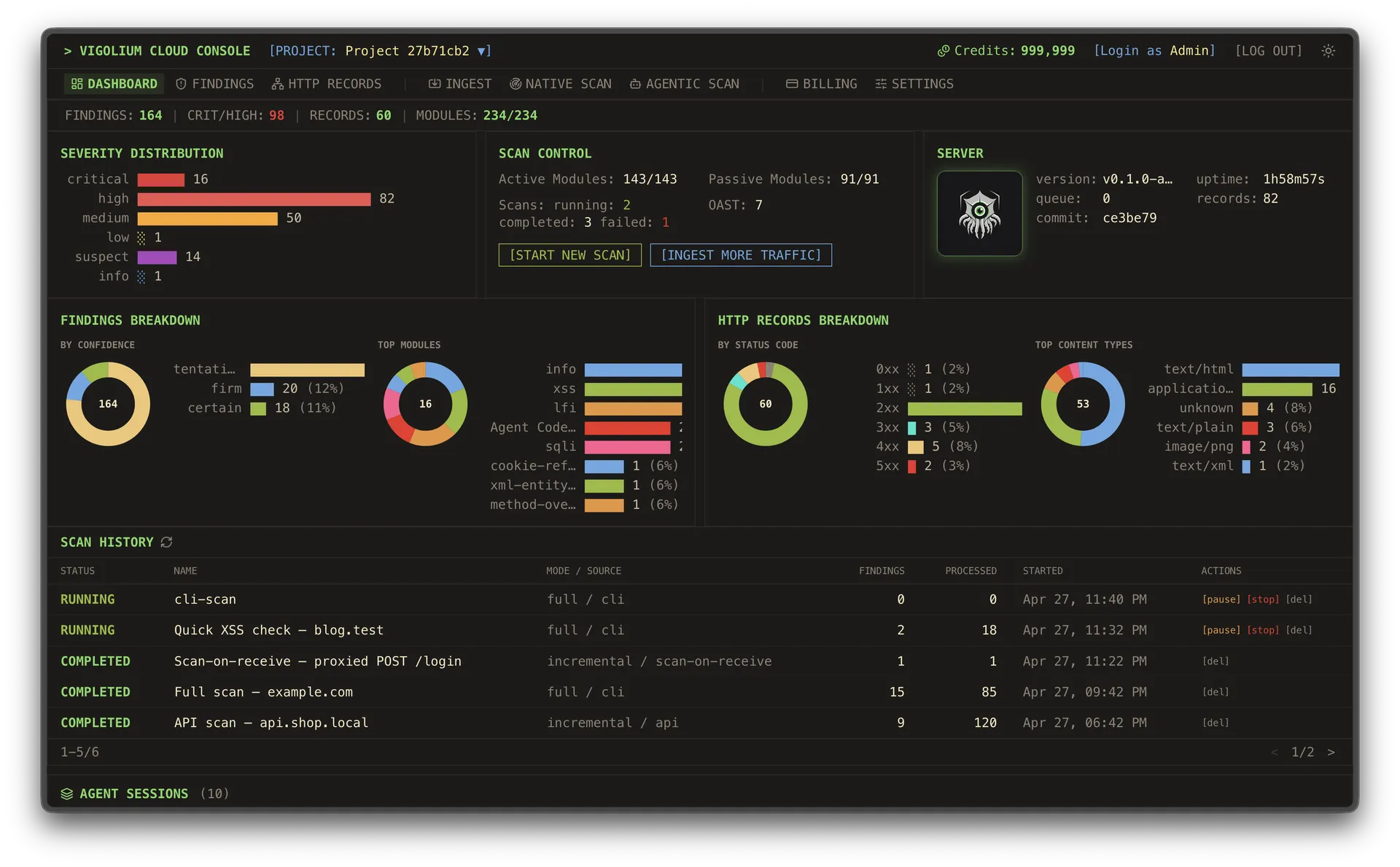
Integrations
CI/CD Pipelines
GitHub Actions, GitLab CI, Jenkins
Burp Suite
Import/export Burp XML traffic
API Server
REST API with Swagger UI and traffic ingestion
OpenAPI / Swagger
Auto-ingest API specifications
AI Backends
Claude, Codex, OpenCode or native LLM call